

Here’s what you need to know:
● Nigeria Customs is rolling out GPS-tracked electronic seals, body cameras,
and non-intrusive scanners across ports and ECOWAS transit routes to
curb container diversion and smuggling.
● The tech is already producing results: a single sweep uncovered N760
million worth of diverted goods, and separate seizures across border
commands have run into the billions of naira.
● But a far larger leak exists on paper, not on the road — Nigeria Customs
disclosed that Import Duty Exemption Certificate approvals hit roughly
N34 trillion in 2025, equal to 61.8% of the entire federal budget that year.
● Delayed rollout of a separate global cargo-tracking standard is meanwhile
costing Nigeria an estimated $500 million annually in lost revenue from
smuggling and under-declared cargo — a reminder that even the tech fixes
are arriving unevenly.
Nigeria Customs is getting genuinely good at catching a truck full of
smuggled tiles or diesel. It’s a much harder question whether it’s catching
the far larger leak that never has to hide in a truck at all — because it’s
approved on paper, in plain sight, through a stamp instead of a
checkpoint.
This is a look at two different kinds of leak in Nigeria’s trade system — the
physical one the new tracking technology is built to catch, and the
paperwork one that dwarfs it in scale.
Leak One: The Physical Leak
Nigeria Customs Service has been deploying an End-to-End visibility
system nationwide, using GPS-enabled electronic seals to track containers
moving from ports like Apapa to inland terminals in Kano and Kaduna,
specifically to prevent diversion of goods in transit.
Comptroller General Bashir Adeniyi framed the effort directly while
unveiling the technology and parading 20 diverted containers seized in
Kano, describing the initiative as aimed at “reducing criminal tendencies,”
with the system offering “real-time cargo monitoring and route verification”
across ports and destination terminals.
The specific results this has already produced are genuinely concrete:
containers of ceramic tiles unlawfully diverted from the Kano Free Trade
Zone, drums of diesel engine oil intercepted at private warehouses, bales
of used clothing seized near border axes — seizures with a combined Duty
Paid Value exceeding N760 million in a single operation alone.
The broader tech stack is worth explaining, since it’s genuinely
comprehensive. Alongside the GPS e-seals, Customs has begun deploying
body cameras on officers, non-intrusive inspection scanners — including
a fixed scanner and gantry scanner at Apapa port — and a homegrown
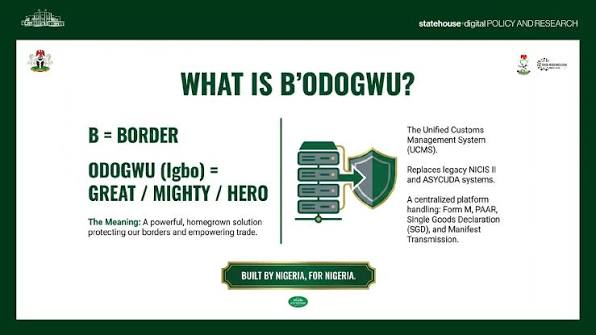
Unified Customs Management System called B’Odogwu, developed with
the Trade Modernisation Project. All of it is aimed at reducing the human
discretion that has historically enabled corruption at the point of
inspection.
Leak Two: The Paper Leak
Here’s the scandal that dwarfs everything covered so far. Nigeria Customs
Service disclosed that Import Duty Exemption Certificate approvals
reached approximately N34 trillion in 2025 — representing 61.8% of the
country’s entire N54.99 trillion federal budget for that fiscal year.
It’s worth explaining what these certificates actually are and why they
matter so much. They’re legal exemptions from import duty, typically
granted for specific policy reasons. But a figure this large, relative to the
entire national budget, raises the obvious question of how much of that
exemption volume reflects legitimate policy versus abuse of a system that
requires no GPS tracker to exploit, because the goods were never hidden
in the first place.
Economists’ reaction captures the scale of concern here. They have
expressed alarm at the figure, calling for a thorough investigation and
warning that the associated revenue loss could widen Nigeria’s fiscal
challenges and increase government borrowing.
The comparison is stark and worth stating directly. A single GPS-tracked
seizure operation recovered goods worth N760 million. The disputed duty
exemption volume for a single year was roughly 45,000 times larger. No
tracking technology currently deployed at Nigerian ports is built to
monitor a certificate that was legally approved.
The Third Leak: The Technology That Hasn’t
Arrived Yet
There’s a further complication worth including, since it shows the tracking
rollout itself is incomplete. Separate from the domestic e-seal system,
Nigeria has delayed implementing the International Cargo Tracking Note
(ICTN) — a global standard designed to provide real-time tracking of
cargo from the port of origin to final destination, with particular value for
monitoring crude oil exports and curbing oil theft.
The cost of that specific delay is direct and significant. The Federal
Government’s failure to implement ICTN has continued to cost Nigeria an
estimated $500 million annually in lost revenue from smuggling,
under-declaration, and procedural delays.
This reveals a pattern across all three leaks. Nigeria’s trade tracking
system is simultaneously advancing quickly in some areas — domestic
e-seals, body cameras — and stalling badly in others, like ICTN, while the
single largest disclosed revenue risk, the duty exemption program, sits
almost entirely outside any tracking conversation at all.

Close: Solving for the Visible Problem
None of the new tracking technology is wasted effort. The seizures are
real, the GPS system genuinely closes off routes smugglers used to exploit,
and the modernization push is a legitimate response to a genuine
problem.
But the scale mismatch is impossible to ignore. A system built to catch a
container of diverted tiles is solving a real but comparatively small
problem, while a N34 trillion certificate approval process — nearly
two-thirds of the national budget — continues to operate with far less
public scrutiny or tracking infrastructure attached to it.
This is the same pattern already documented elsewhere in this blog with
the ETLS certificate of origin system — a paper-based approval process,
not a smuggled shipment, turning out to be the harder, less visible leak to
actually track.