

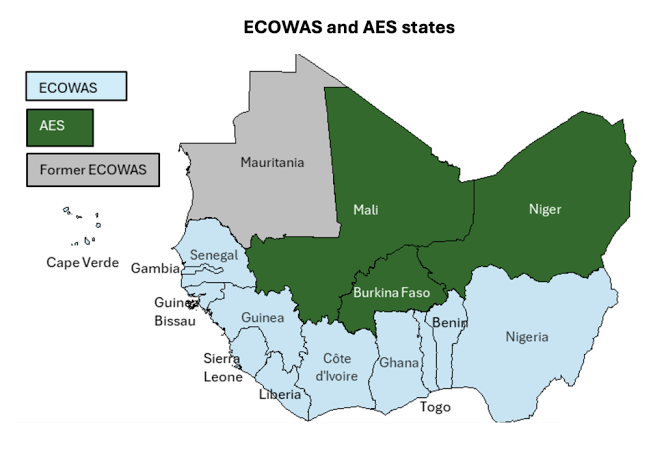
● Trade economists warn AES tariff threatens both ECOWAS trade and the
AfCFTA’s broader integration goals. (April 2025)
In April 2025, economists issued a warning that landed heavily: AES’s new 0.5%
tariff doesn’t just threaten ECOWAS trade. It threatens the legal foundation of the
African Continental Free Trade Area itself — a project 54 countries spent years
building.
Here’s the twist. The specific kind of violation economists are worried about — a
country ignoring AfCFTA’s zero-tariff principle to protect its own producers —
isn’t new, isn’t hypothetical, and isn’t only an AES problem. Nigeria has been
doing a version of exactly this for years.
AES gets the headlines for breaking the rules. Nigeria wrote a chapter of this
same playbook years earlier — and it cost Ghana and Benin 65% of their trade
with each other.
Here’s What Actually Happened
Both AfCFTA and the ETLS are built on the principle of zero tariffs on eligible
goods traded within the region. That’s not a footnote in either agreement — it’s
the entire economic logic both frameworks depend on holding.
Here’s precisely why AES’s levy breaks that principle. A flat 0.5% tariff applied
uniformly to incoming goods, including goods originating from other ECOWAS or
African Union member states, directly violates the zero-tariff rule both
frameworks are built on.
The specific warnings economists raised in April 2025 were direct: the new tariff
“will cripple regional trade and fuel insecurity in the region,” it “opens the door to
legal challenges under the AfCFTA and ECOWAS dispute settlement
mechanisms,” and if left unresolved, it could weaken enforcement mechanisms to
the point of making the agreements “toothless.”
Here’s the myth-check. AES’s trade with the rest of ECOWAS is actually relatively
small in absolute terms for a country like Nigeria. That means the real danger
economists are flagging isn’t the direct trade volume affected — it’s the
precedent. If one member can simply ignore the zero-tariff rule when it’s
politically convenient, the entire legal architecture holding these agreements
together gets weaker for everyone, not just for AES’s immediate trading partners.
The Scandal: Nigeria Already Wrote This Playbook
Here’s the sharpest evidence that this isn’t a uniquely AES problem. Within
ECOWAS itself, Nigeria has maintained substantial tariffs on textiles, rice, wheat,
and processed foods specifically to shield its own domestic producers — even
though these products are major exports for neighboring Benin and Ghana.
The documented consequence is worth stating plainly. This exact kind of
tariff-driven trade tension is what led directly to Nigeria’s 2019-2020 border
closures already covered elsewhere in this series. The resulting damage was
severe: Ghana-Benin trade collapsed by 65%.
This is structurally the same type of violation economists are warning about with
AES’s new levy — a member state prioritizing domestic protection over the
zero-tariff commitments it signed onto, undermining faith in the agreement and
making cross-border investment harder for businesses to plan around.
There’s a final layer to this scandal worth including, because it shows the
correction was incomplete. Under pressure, Nigeria did move to waive taxes on
African-origin goods in April 2025 — but only on 90% of goods traded, not all of
them. Even Nigeria’s corrective action left a real gap between AfCFTA’s stated
zero-tariff principle and Nigeria’s actual practice.
Why the Double Standard Matters More Than the Tariff Itself
Here’s the deeper argument worth making directly. If AfCFTA and ETLS
enforcement only gets invoked loudly against a politically isolated bloc like AES,
while a founding member’s years of comparable tariff behavior draws far less
sustained scrutiny, that selective enforcement pattern is itself a threat to the
frameworks’ credibility — arguably a bigger one than any single tariff.
The informal-fee dimension shows the problem extends beyond formal tariffs
entirely. According to the UN Economic Commission for Africa, informal
payments at borders — often tariff-related in nature — remain widespread across
the continent, reportedly amounting to as much as 17% of the cost structure for
some manufacturing firms.
There is a constructive alternative economists have proposed, worth including
here rather than ending on pure criticism. Rather than resorting to tariffs, AES
has been urged to strengthen domestic tax collection instead — improving VAT
systems, expanding the formal tax base, and using digital tools like mobile
money tracking and e-filing, citing Rwanda’s success raising revenue this way
without raising tariffs at all.
This connects directly back to the checkpoint economy already documented in
this series. A shift toward formal, digitized domestic taxation would represent a
genuine alternative to both the AES levy and the informal checkpoint bribery
economy already covered — two different mechanisms currently extracting value
from the same struggling trade corridors.
The Myth vs. The Reality
| What people assume | What actually happened |
|---|---|
| AES’s tariff is an unprecedented threat to AfCFTA that no other member state has caused | Nigeria’s own tariffs on textiles, rice, wheat, and processed foods directly contributed to a 65% collapse in Ghana-Benin trade during the 2019-2020 border closures |
| Nigeria’s criticism of the AES tariff comes from a position of clean compliance with AfCFTA rules | Nigeria’s April 2025 tax waiver covered only 90% of traded goods, not all of them |
| The main risk from AES’s tariff is the direct trade volume it affects | Economists warn the deeper risk is precedent and enforcement credibility, since AES’s actual trade volume with the rest of ECOWAS is relatively small |
| Enforcement of AfCFTA’s zero-tariff principle is applied evenly across member states | Enforcement scrutiny has fallen far more heavily on the politically isolated AES bloc than on founding members with comparable histories |
Why This Still Matters
AES’s 0.5% tariff deserves the scrutiny it’s getting. But treating it as an isolated,
uniquely AES problem misses the pattern this series keeps uncovering — that
zero-tariff commitments across West Africa have been selectively honored by
nearly every major player when it suited them.
AfCFTA and the ETLS won’t survive on the strength of their written rules alone.
They’ll survive, or fail, based on whether enforcement applies evenly, to founding
members and breakaway blocs alike.