

A Historical In-depth Discovery of Trade in West Africa Since 1896
Here’s what you need to know;
- Nigeria and Benin launch SIGMAT (Interconnected System for the Management of Goods in Transit) to digitalize and harmonize cross-border customs data. (May 2025)
A shiny new digital customs platform, officially launched at a border post, framed by officials as a “powerful demonstration of regional solidarity.”
That’s how this story got announced. Read past the ribbon-cutting language, though, and the official press materials list, in plain terms, exactly what this new system exists to fix — goods diversion, revenue leakage, bureaucratic delays, and a “proliferation of checkpoints.” That’s not a wish list. That’s a confession.
You don’t build a system specifically designed to stop diversion and leakage unless diversion and leakage were actually happening — for years, at scale, on one of West Africa’s busiest trade corridors.

Here’s What Actually Happened
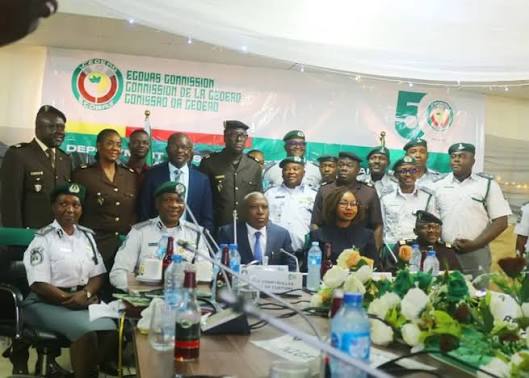
On May 19, 2025, Nigeria and Benin officially launched the Interconnected System for the Management of Goods in Transit (SIGMAT) at the Sèmè-Kraké Joint Border Post, on the Abidjan-Lagos corridor — described by ECOWAS officials as the most important trade corridor in the region by trade volume.
Here’s what SIGMAT actually does, in plain terms. It’s an IT platform that replaces paper-based customs documentation with real-time electronic data-sharing between Nigerian and Beninese customs systems, tracking goods in transit end-to-end and issuing electronic transit documents like the ECOWAS Transit Guarantee.
The timeline here deserves attention. This wasn’t a rushed, reactive rollout. SIGMAT was first introduced as a concept back in 2019, and Nigeria’s own Customs Comptroller-General, Wale Adeniyi, described it as an idea that had been “conceived for over a decade” before finally deploying at this specific, high-volume border post in 2025.
Here’s the myth-check. SIGMAT wasn’t invented in response to any single scandal or crisis. It’s part of a broader, decade-long ECOWAS digitalization push, already operating in nine member states by the time of this Nigeria-Benin launch. What makes this particular deployment significant is the corridor it’s finally reaching, not the technology itself being new.
The Scandal: What the System Was Actually Built to Stop
Here’s the admission, pulled straight from official coverage of the launch. Reporting on the initiative states plainly that it was designed to tackle “long-standing issues such as goods diversion, revenue loss, bureaucratic delays and the proliferation of checkpoints along the Nigeria-Benin corridor.”
It’s worth unpacking what each of those terms actually means in practice, since they’re being stated diplomatically. “Goods diversion” means shipments declared for one destination quietly ending up somewhere else, evading the duties or restrictions that would have applied. “Revenue loss” means customs duties that should have reached government treasuries never arriving. “Proliferation of checkpoints” is the same phenomenon already documented elsewhere in this series — informal stops along legitimate routes, each one an opportunity for a bribe rather than a legitimate inspection.
This connects directly to earlier reporting already covered in this blog. An industry association vice president had gone on record describing Nigeria’s Customs Service as “synonymous with corruption,” alleging that smuggling networks operated “with a cabal” tied to Customs itself. SIGMAT’s own stated objectives read like an implicit acknowledgment that this criticism had real substance.
This isn’t a system responding to a single dramatic event. It’s a system whose design brief amounts to a quiet institutional confession that West Africa’s busiest trade corridor had spent years bleeding revenue and integrity through exactly the kind of informal extraction this blog has already documented happening elsewhere in the region.
Can Software Actually Fix a Corruption Problem?
The theory of change behind SIGMAT is worth explaining plainly. By replacing paper documents — which can be altered, lost, or bypassed — with real-time shared electronic data between two countries’ customs systems, the system is meant to remove the discretion and opacity that made diversion and bribery possible in the first place.
The specific mechanics back this up: electronic transit documents tracked in real time, automated alerts for any deviation from a shipment’s declared route, and direct interoperability between Nigerian and Beninese systems — designed so a shipment leaving Lagos for Cotonou can’t quietly disappear into an undeclared detour without triggering a flag.
Here’s the honest, necessary skepticism a system like this deserves. A digital platform can reduce the opportunities for a certain kind of paper-based fraud, but it cannot, on its own, eliminate physical checkpoints staffed by people who choose to demand a bribe regardless of what the electronic paperwork says. SIGMAT addresses the documentation half of this problem more directly than it addresses the checkpoint-extraction half.
Officials themselves seem to treat this as unfinished business. Nigeria’s Customs Comptroller-General announced plans to extend SIGMAT to additional border stations, including Idiroko and Chikanda, alongside a dedicated task force to track the system’s successes and ongoing challenges.
The Myth vs. The Reality
| What people assume | What actually happened |
| SIGMAT is a brand-new response to a fresh crisis | It’s the product of a decade-long ECOWAS digitalization effort finally reaching this specific corridor |
| Officials launched SIGMAT purely as a forward-looking modernization initiative | Its own stated objectives explicitly name goods diversion, revenue leakage, and checkpoint proliferation as the problems being addressed |
| These problems are being reported here for the first time | This blog has already documented named, on-record sources describing near-identical corruption concerns on Nigeria’s borders |
| Digitizing customs paperwork will fully resolve the corridor’s corruption problems | The system targets the paperwork side of the problem more directly than the human checkpoint side |
Why This Still Matters
SIGMAT is genuinely a useful infrastructure, and its launch deserves to be reported as real progress. But its own design brief, read carefully, functions as an official acknowledgment of exactly the kind of extraction economy already documented on Nigeria’s borders elsewhere in this series.
Whether a digital tracking system can outpace a checkpoint economy built on cash, discretion, and physical control of the road will be the real test of SIGMAT’s success — not the ribbon-cutting ceremony, but what the diversion and revenue numbers actually look like a few years from now.
Sources and further reading.