

● ECOWAS Trade Liberalisation Scheme (ETLS) implementation reviewed amid AES
fallout, with regional bodies working to shore up the scheme’s credibility. (2025)
To get duty-free treatment under ETLS, a trader needs one thing above all else:
an ECOWAS Certificate of Origin, proving the goods actually came from within
the region.
This is a forensic look at that document — what it’s supposed to prove, how the
system built around it has been gamed, and what ECOWAS is actually doing in
2025 to restore trust in a scheme now approaching its 50th year.
Section One: What the Document Is Supposed to Prove
The ECOWAS Trade Liberalisation Scheme (ETLS) was established in 1979, initially
covering only agricultural products, handicrafts, and unprocessed goods, before
expanding in 1990 to include manufactured industrial products. The scheme’s
core purpose is eliminating customs duties and non-tariff barriers on goods
genuinely produced within ECOWAS.
The certificate itself requires specific “rules of origin” criteria to be met —
generally a defined minimum value-added component actually produced within
the ECOWAS region — verified through an approval process involving national
trade bodies. In Nigeria, for example, this runs through NACCIMA and the
Nigeria Customs Service before a Certificate of Origin can actually be issued.
It’s worth clarifying precisely why this matters economically. ETLS-certified goods
are meant to be genuinely cheaper and more competitive than goods imported
from outside the region, specifically because of the concessionary duty
treatment the certificate unlocks. The entire economic incentive of the scheme
depends on that certificate reliably meaning what it claims to mean.
Section Two: Where the Paper Trail Breaks Down
ECOWAS’s own review process has flagged non-tariff barriers, inadequate
stakeholder awareness, and inconsistent implementation across member states
as ongoing, persistent challenges — nearly fifty years after the scheme’s creation.
Here’s the scandal, and it’s sourced directly to ECOWAS’s own corrective action. In
November 2024, ECOWAS launched an electronic Certificate of Origin system
specifically, in its own stated words, “to combat fraudulent practices while
facilitating legitimate trade.” That’s a direct institutional admission that the
paper-based certificate system had become vulnerable to exactly the kind of
forgery and misuse it was designed to prevent.
It’s worth naming what this fraud actually looks like in practice. Goods genuinely
manufactured outside ECOWAS being falsely certified as ECOWAS-origin,
specifically to dodge the region’s Common External Tariff — turning a scheme
meant to reward regional producers into a loophole that could, in the wrong
hands, undercut them instead.
Here’s the scandal’s core point, stated precisely. For nearly five decades, the
entire economic logic of ETLS rested on a paper document that ECOWAS itself
has now formally acknowledged was vulnerable enough to require a full digital
overhaul.
Section Three: The Digital Fix, and Its Limits
The corrective measures ECOWAS is currently pursuing are worth explaining
directly, since this is where the 2025 review comes in. Regional bodies meeting in
Accra pushed for enhanced ETLS implementation, emphasizing training,
stakeholder sensitization, and continued adoption of digital certification systems
as the path toward restoring the scheme’s credibility.
It’s worth being honest about what a digital certificate can and can’t fix, echoing
a pattern already documented elsewhere in this blog with the SIGMAT system.
Digitizing a certificate makes it harder to physically forge or alter, but it doesn’t
independently verify that the underlying claim — that goods genuinely
originated within ECOWAS — was true in the first place, unless the verification
process behind the certificate is equally rigorous.
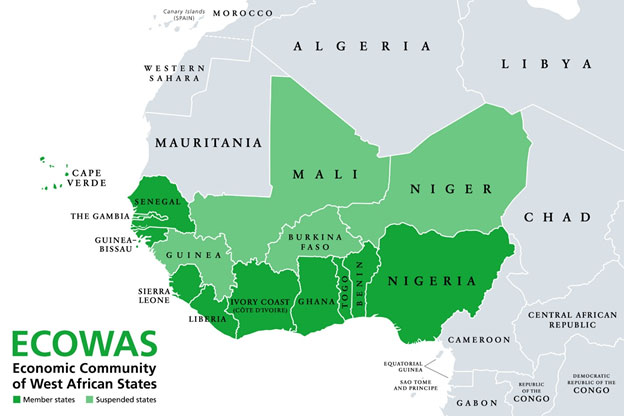
There’s an AES fallout dimension worth bringing in directly, since it’s the current
context driving urgency around this review. With Mali, Burkina Faso, and Niger’s
departure reshaping the region’s trade map entirely, and new tariffs and
workaround corridors already documented extensively in this blog, ECOWAS has
real institutional incentive to demonstrate that its remaining flagship trade
instrument still functions with integrity.
Close: What the Paper Actually Proves Now
The certificate of origin was always meant to be a simple, trustworthy signal —
this good is genuinely regional, treat it accordingly — and for nearly fifty years,
that signal has been undermined by inconsistent implementation and, by
ECOWAS’s own admission, real fraud.
Genuine credibility restoration would require more than a digital signature
replacing a paper stamp. It would require consistent verification standards and
enforcement across fifteen member states with very different administrative
capacities — a considerably harder problem than the technology upgrade alone
can solve.
This is the quiet infrastructure sitting underneath every other ETLS-related story
already covered in this blog — the AES tariff dispute, the Ghana-Nigeria tariff
parallels, the border-corridor workarounds. All of it depends on a document
whose reliability ECOWAS itself only recently admitted needed fixing.