

A Historical In-depth Discovery of Trade in West Africa Since 1896
Here’s what you need to know:
- The Omu of Onitsha was a female monarch who governed alongside the Obi (the male king) in a genuine dual-sex political system, with her own cabinet of titled women councilors and a market police officer called the awo enforcing her rules.
- The last Omu, Nwagboka, died in 1886 — the same decade British forces bombarded Onitsha (1879–1889) — and no successor was ever named to the office again.
- The scandal: when Britain formally imposed “indirect rule” across Igboland after 1900, it created an entirely male Warrant Chief system, with no equivalent female institution at all — erasing centuries of women’s formal governing authority in a single administrative stroke.
- That erasure fed directly into the 1929 Aba Women’s War, where colonial soldiers killed 53 unarmed women protesters — women who were using organizing tactics directly inherited from the market governance system colonialism had already dismantled.
Onitsha didn’t have one monarch. It had two — a king, the Obi, and a queen, the Omu, governing in genuine consultation with each other. Only one of those two thrones survived into the twentieth century.
This is the story of what the Omu actually governed, how the institution quietly died at almost the exact moment colonial pressure intensified, and the massive, violent consequence that followed when colonial administrators built a new government with no place for her successor at all.
Act One: What the Omu Actually Governed
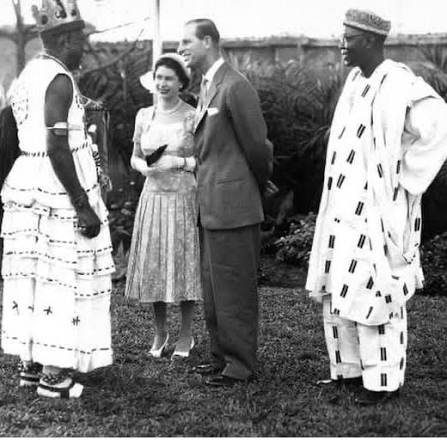
The office is worth explaining plainly, since its real scope surprises most readers. The Omu presided over the market and all women’s affairs in Onitsha, holding ceremonial and political standing nearly equivalent to the Obi’s own — attending council meetings, and governing alongside him rather than beneath him.
The institutional machinery this office actually commanded is worth bringing in. The Omu led a cabinet of titled women councilors called the ilogu, and appointed a market police officer known as the awo, whose job was enforcing market law directly.
It’s worth explaining what “governing the market” actually meant in practice, since it wasn’t symbolic. The Omu and her cabinet fixed the prices of market goods, defined market prohibitions — including specific rules like requiring palm produce to be sold unbundled rather than in bunches, and peppers to be boiled before sale — and functioned as a genuine court, trying and punishing wrongdoers the awo brought before them.
The office’s enforcement power extended beyond the market itself. Onitsha women under the Omu’s authority could organize collective sanctions against men who violated social norms — from public shaming to mass work stoppages — a documented form of institutionalized political leverage, not informal social pressure.
Act Two: How the Institution Quietly Died
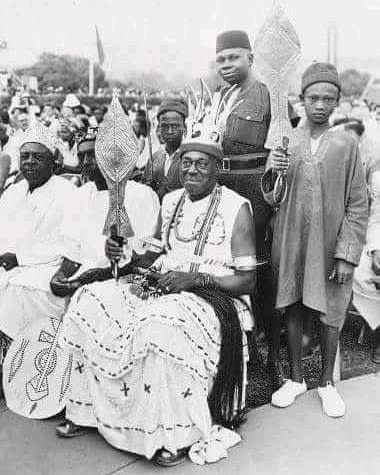
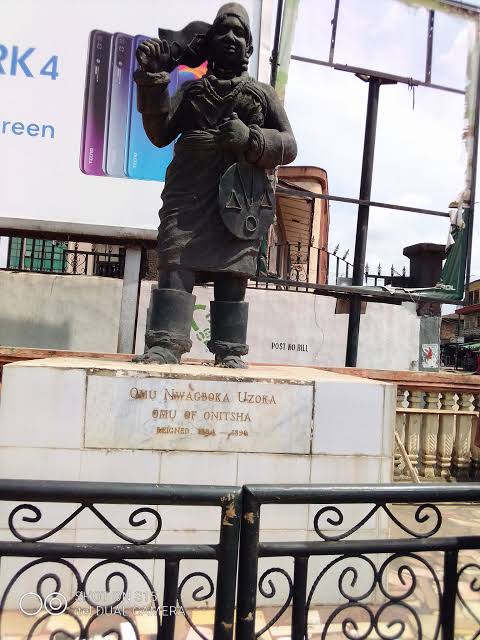
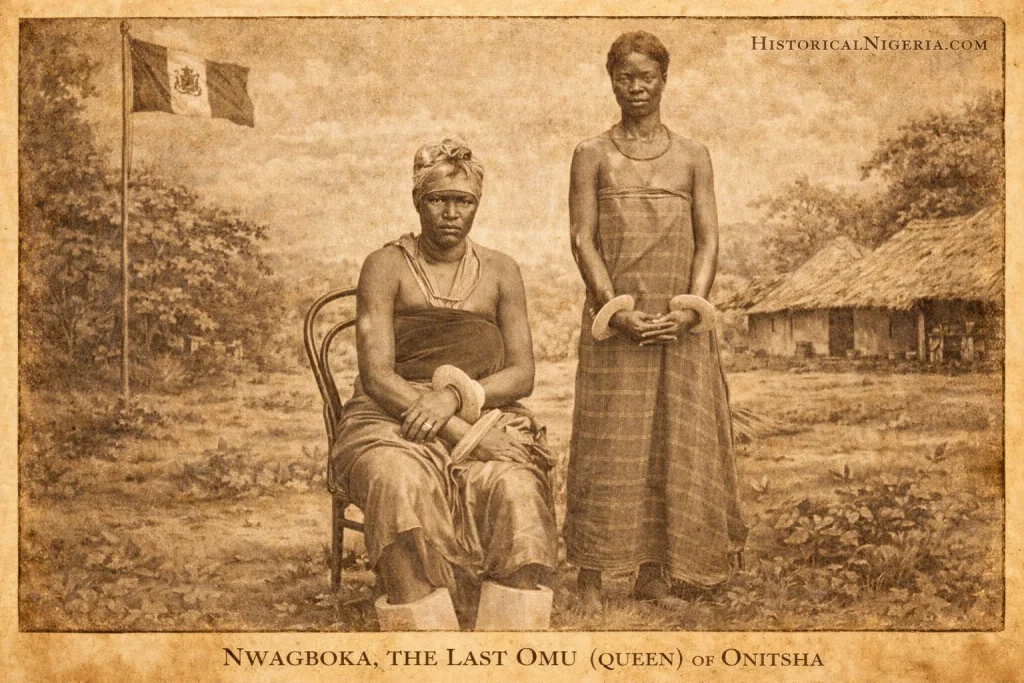
The last Omu is worth introducing directly. Nwagboka, who held the office until her death in 1886, is remembered specifically for leading the Ikporo Onitsha — the full association of Onitsha’s wives — in a coordinated 1886 strike against Obi Anazonwu, an all-women boycott of social duties intended, in the words of one historian, “to remind the community that no society can function without the duties and tasks performed by its women.”
There’s a timing detail that deserves far more attention than it usually gets, since it sits right alongside a documented colonial military action. Nwagboka’s death in 1886 fell within the same decade that British merchants and missionaries bombarded Onitsha, between 1879 and 1889 — meaning the Omu institution’s collapse wasn’t a purely internal succession failure happening in isolation. It coincided directly with the exact period Onitsha was under sustained external military and commercial pressure from Britain.
Here’s what happened next, stated plainly. After Nwagboka’s death, no successor was ever named to the Omu-ship. Onitsha has had only a male monarch ever since.
What remained afterward is worth noting, since the office didn’t disappear entirely, even if its power did. The excised constitutional powers were absorbed into a diminished position, the Onye-isi-ikporo-Onitsha (head of Onitsha women), with automatic succession to the next oldest surviving woman — a title still respected in Onitsha today, but explicitly described by researchers as holding powers “nowhere near” what the precolonial Omu once commanded.
The Scandal: Building a Government With Only Half the Seats
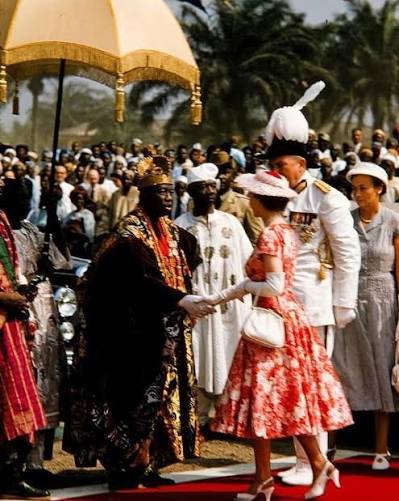
Here’s the piece’s central argument. When Britain formally extended “indirect rule” across Igboland after establishing the Southern Nigeria Protectorate in 1900, it built an entirely new local governing structure from scratch — and that structure had no female institutional counterpart at all.
The Warrant Chief system is worth explaining precisely, since it’s essential to understanding what got erased. Colonial administrators, lacking the kind of centralized male rulers they were used to working with in northern Nigeria, invented a system of “Warrant Chiefs” — local men, often wealthy traders or colonial collaborators with no traditional legitimacy — issued formal warrants authorizing them to preside over native courts, adjudicate disputes, and collect taxes.
The erasure is worth stating explicitly. This new colonial governing structure replaced a dual-sex system, in which women held formal, enforceable authority over markets, trade regulation, and gender-related disputes, with a system built entirely around individual men — many of whom held no traditional claim to authority at all, let alone the kind of consultative legitimacy the Obi-Omu relationship had once required.
This wasn’t simply an oversight. Colonial administrators weren’t merely failing to recognize an institution they didn’t understand. They were replacing a functioning, centuries-old system of shared governance with a structure that formally excluded the entire half of society the old system had specifically empowered.
The Reckoning: What Happened When the Erasure Caught Up
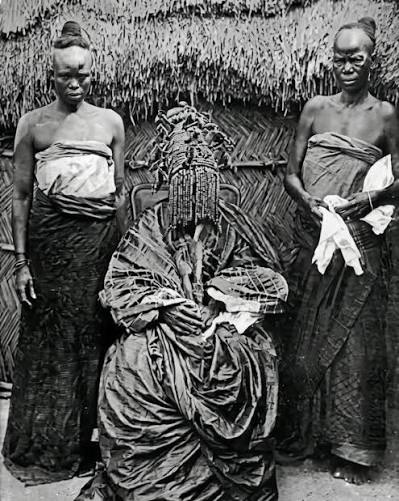
Bring the story to its devastating consequence directly. In November 1929, the Women’s War — known in Igbo as Ogu Umunwanyi — erupted across colonial Nigeria’s Eastern provinces, a mass uprising triggered by new taxation, warrant chief abuses, and collapsing agricultural prices during the Great Depression.
There’s a direct institutional inheritance connecting this uprising back to the Omu era, worth including since it’s the sharpest evidence of continuity. The protest tactics women used in 1929 — mass sit-ins, coordinated confrontation of offending men, and the practice known as “sitting on a man” — were documented as directly inherited from precolonial methods of collective female enforcement, the exact same toolkit the Omu’s market governance system had once formally sanctioned.
The human cost is worth stating plainly. Colonial forces met the protests with armed soldiers, and 53 unarmed women protesters were killed.
The government’s own findings afterward are worth noting, since even colonial administrators eventually acknowledged part of what had gone wrong. The Aba Commission of Enquiry’s 1930 report documented widespread abuses by warrant chiefs who “lacked traditional legitimacy in Igbo society,” leading Britain to formally abolish the warrant chief system in the riot-affected provinces and, for the first time, appoint women to serve on the reformed native courts.
The Myth vs. The Reality
| What people assume | What actually happened |
| Precolonial Igbo society had no formal female political authority for colonialism to disrupt | The Omu of Onitsha held genuine, enforceable governing authority over markets and gender relations, functioning as a formal co-ruler alongside the Obi |
| The 1929 Aba Women’s War was a spontaneous, unprecedented uprising with no deeper historical roots | Its organizing tactics were directly inherited from the same precolonial system of institutionalized female authority the Omu institution had once formalized |
| Colonial “indirect rule” simply adapted existing local governance structures | It built an entirely new, male-only Warrant Chief system with no female institutional counterpart, replacing a dual-sex governing tradition |
| The Omu institution ended because of a direct colonial decree abolishing it | It lapsed through an internal succession failure after Nwagboka’s 1886 death, coinciding with, rather than being directly caused by, British military and commercial pressure on Onitsha |
Close: The Seat Nobody Ever Refilled
The Omu’s throne emptied quietly, through succession failure rather than direct colonial decree — but the government Britain built afterward made a deliberate, structural choice never to make room for it again, replacing a dual-sex system of governance with one that formally recognized only half of it.
Understanding the scale of the 1929 Aba Women’s War — and the 53 lives lost to it — means understanding what had already been quietly erased decades earlier, when a market governed for centuries by queens, cabinets, and a woman’s own police force was handed over entirely to men whose only real qualification was a piece of paper from a colonial office.
Sources and further reading.