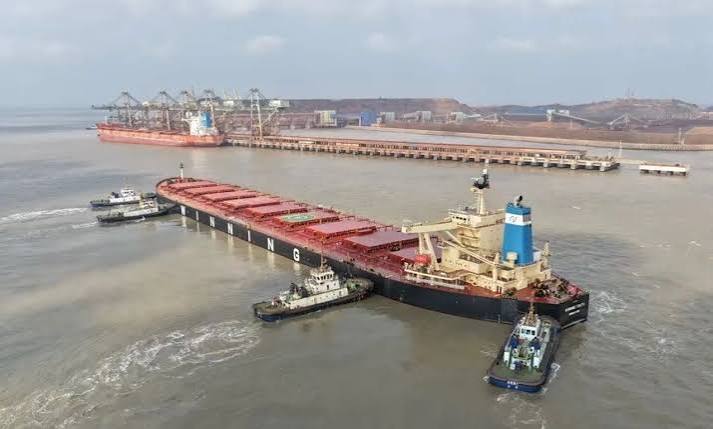
In December 2025, Guinea shipped its first cargo of Simandou iron ore to China,
ending over two decades of delays on what’s considered Africa’s largest
greenfield mining and rail infrastructure project.
Here’s the real reason for those two decades. This project didn’t stall because of
engineering problems or funding gaps alone. It stalled because the company
that first won the rights to it got them through one of the most brazen,
well-documented bribery schemes in African mining history — and the fallout
took years of criminal trials, arbitration cases, and international investigations
to clear.
Before a single train ran on this railway, a company paid millions of dollars to a
president’s wife to make sure it got the mine — and then flipped half its stake for
a $2.5 billion profit before ever extracting a ton of ore.

Here’s What Actually Happened
Simandou is considered the world’s largest untapped high-grade iron ore
deposit, containing billions of tonnes of ore, located in the remote forested
interior of southeastern Guinea.
Mining giant Rio Tinto held exploration rights across the Simandou range for
years, doing the early work of identifying and assessing the deposit’s scale.
Here’s the pivot point. In 2008, Guinea’s ailing dictator, President Lansana Conté,
stripped Rio Tinto of its rights to two of the four Simandou blocks and handed
them instead to a company called Beny Steinmetz Group Resources (BSGR) — a
company with no prior experience in iron ore mining — for $160 million.
Here’s the myth-check. This wasn’t a routine change of mining license, decided on
commercial merit. Testimony later given in both a World Bank arbitration tribunal
and a Swiss criminal trial described Conté personally summoning his own mines
minister and demanding Rio Tinto’s rights be cancelled “quickly,” with witnesses
testifying they understood the president’s wife was directly pressuring him on
BSGR’s behalf.
The Scandal: How an $8.5 Million Bribe Bought the World’s
Richest Iron Deposit
The documentation here is unusually thorough. Global Witness, working with
leaked contracts, FBI wiretap transcripts, and signed cheques, documented what
Geneva prosecutors would later call a five-year “corruption pact,” running from
2005 to 2012, between BSGR and Mamadie Touré — one of President Conté’s wives.
The payment structure is worth laying out plainly. Contracts showed BSGR and its
intermediaries promising Touré millions of dollars in “commission” payments,
funneled through a British Virgin Islands company called Pentler Holdings, which
held a 17.65% share of BSGR’s Guinea operations — alongside a further pledge of
5% of BSGR’s Simandou shares directly to Touré’s own company, Matinda.
The financial payoff that made the scheme worth it is staggering, and the
numbers alone tell the story. After acquiring the Simandou rights for $160 million
in 2008, Steinmetz sold 51% of BSGR’s stake to Brazilian mining giant Vale just two
years later, in 2010, for $2.5 billion — a return that dwarfs almost any legitimate
acquisition in African mining history.
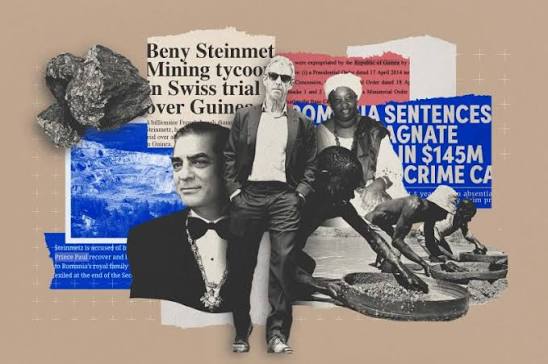
The reckoning eventually came. In January 2021, a Geneva court convicted
Steinmetz of bribing Mamadie Touré with $8.5 million, sentencing him to five
years in prison. Separately, Vale won a $2 billion fraud judgment against BSGR in
a 2019 London arbitration, after arbitrators found BSGR had made fraudulent
representations to induce Vale’s original investment.
Twenty Years Lost to a Deal That Was Rotten From the Start
There’s a direct line from this scandal to the two-decade delay referenced in this
essay’s headline. Guinea’s incoming government under President Alpha Condé
launched a corruption probe into the BSGR deal after taking office, and in 2014,
formally revoked BSGR’s Simandou rights once that investigation concluded they
had been obtained through bribery.
Here’s what followed, and it’s exactly what stalled the project for years afterward.
BSGR responded with an international arbitration claim against Guinea itself,
while simultaneously fighting Vale’s $2 billion fraud judgment and Steinmetz’s own
personal Swiss criminal prosecution — layering years of overlapping legal battles
across multiple countries onto a mining project that, at its core, simply needed
stable ownership and financing to move forward.
Every year these legal disputes dragged on was a year Guinea’s most valuable
natural resource sat undeveloped, un-mined, and unable to generate the
national revenue, jobs, and infrastructure investment it was always capable of
producing — a direct cost paid by ordinary Guineans for a deal they never
negotiated and never benefited from.
Only after BSGR’s rights were fully stripped, the legal disputes substantially
resolved, and new investment and infrastructure partnerships established
around a 600-plus-kilometer trans-Guinean railway did Simandou’s iron ore finally
begin moving to port.
The Myth vs. The Reality
| What people assume | What actually happened |
|---|---|
| Simandou’s two-decade delay was primarily due to the technical and financial complexity of building major mining infrastructure in a remote region | The original rights transfer to BSGR in 2008 was later proven in a Swiss criminal court to have been secured through millions of dollars in bribes to the president’s wife |
| The mining rights disputes over Simandou were standard commercial disagreements between companies | Untangling the resulting ownership, arbitration, and criminal cases took the better part of a decade before the project could move forward on stable footing |
| BSGR’s $160 million acquisition and later $2.5 billion sale to Vale reflected the deposit’s genuine rising value | The scale of that markup, combined with the bribery findings, was central evidence in the fraud judgment Vale later won against BSGR |
| Guinea’s government simply changed its mind about who should hold the mining rights | Guinea revoked BSGR’s rights only after a formal corruption investigation concluded they had been obtained illegally |
Why This Still Matters
This is a striking, well-documented example of exactly the pattern this series
keeps finding across West African resource extraction — a deal secured through
corruption doesn’t just cheat the country out of fair value in the moment, it can
delay that resource’s actual development by decades, compounding the cost to
ordinary citizens far beyond the original bribe.
The ships now carrying Simandou’s iron ore to China represent a genuine
milestone for Guinea. But they’re also sailing on a timeline that could have
started twenty years earlier, if the deal that first opened this deposit hadn’t been
built on a bribe to a dictator’s wife.