

Here’s a twist most people don’t expect: the currency Europeans used to buy
enslaved people from West Africa wasn’t African at all.
It was manufactured in Birmingham, England. Cast in industrial workshops,
shipped over by the boatload, designed specifically to match the shapes and
standards African markets would actually accept.
Meanwhile, in the same region, a completely different economy was running on
something else entirely. Salt, in some markets, was traded close to its weight in
gold. And gold itself wasn’t just handed over loosely — it was measured using a
precision brass weighing system so exact that owning a complete set of weights
marked a man as a legitimate, trustworthy merchant.
Three currencies. Three completely different stories. All erased by the same
system.
Here’s What Actually Happened — Part One: Manillas
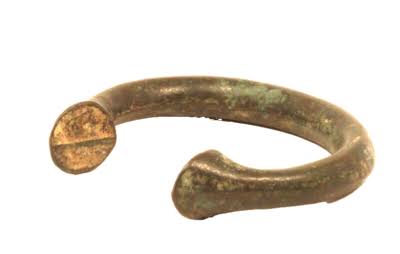
Manillas were open, horseshoe-shaped metal bracelets, cast in copper, brass, or
bronze, worn and traded as currency across West Africa from the late 15th
century into the 20th.
Here’s the twist that surprises most people: by the 19th century, most manillas
circulating in West Africa weren’t made there at all. They were manufactured
almost exclusively in industrial British cities — especially Birmingham, and
earlier, Bristol — based on designs African traders had already established as
acceptable and valuable. European manufacturers weren’t inventing a new
currency and forcing it on African markets. They were reverse-engineering an
existing one to profit from it.
And they weren’t uniform. Different types carried different names and different
accepted values in different regional markets — the smaller Popo manilla,
manufactured specifically for the slave trade; the Okpoko or Mkporo type,
common in Calabar and among Igbo communities. A merchant moving between
regions needed to know which type was valued where.
Here’s the myth-check. Manillas are remembered almost entirely as “slave trade
money,” and that reputation is earned — a person could be bought for roughly a
dozen manillas in the late 15th century, with that price climbing substantially
over the following century as demand grew. But that’s not the whole story.
Manillas also functioned as ordinary currency for legitimate agricultural and
craft trade for centuries, including well after Britain formally abolished its own
participation in the slave trade. Reducing them to only their darkest use erases
how deeply embedded they were in everyday commerce.
Here’s What Actually Happened — Part Two: Gold
Dust and the Akan Goldweight System
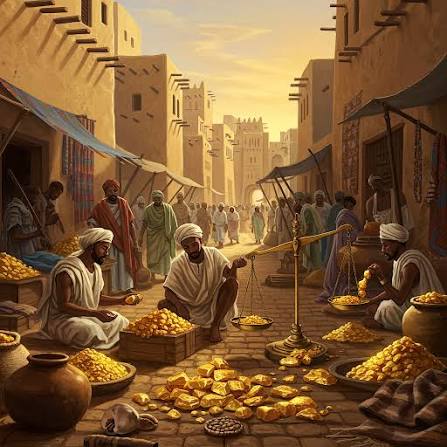
Shift now to the Akan peoples of what’s today Ghana and Côte d’Ivoire — and the
Asante in particular — whose economy ran for centuries on gold dust as
currency.
Gold dust alone isn’t a practical currency without a reliable way to measure it.
That’s where the Akan goldweight system comes in — known locally as mrammuo,
or abrammuo. These were small, precisely cast brass weights, made using the
lost-wax casting method, used to measure exact quantities of gold dust in every
kind of transaction: everyday market trade, state taxes, royal tolls.
This wasn’t a crude or improvised system. The weights themselves were miniature
works of art, cast into geometric patterns, animals, and human figures, many of
them directly referencing Akan proverbs and cultural wisdom. And they carried
real social weight, too — owning a complete set of goldweights marked a man as
a legitimate, trustworthy merchant, and complete small sets were even given as
gifts to newly married men entering trade for the first time.
None of this developed in isolation. The system drew on earlier weighing
standards introduced through trans-Saharan trade with the Islamic world,
adapted and refined by Akan craftsmen over centuries. This was a currency and
measurement system shaped by generations of cross-regional commercial
contact — not an isolated local invention waiting to be “discovered” and
modernized by Europeans.
Here’s What Actually Happened — Part Three:
Salt as Currency
Now for the currency that’s easiest to overlook, because it doesn’t look like
currency at all: salt.
Naturally occurring salt deposits were almost nonexistent across much of West
Africa, which made it genuinely scarce — and genuinely essential for both diet
and food preservation. That scarcity is what turned it into a currency in its own
right.
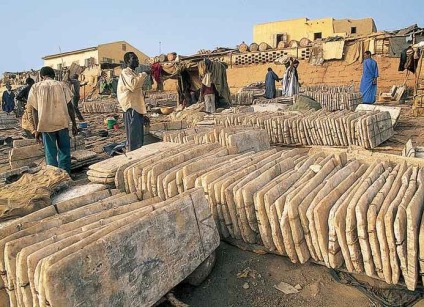
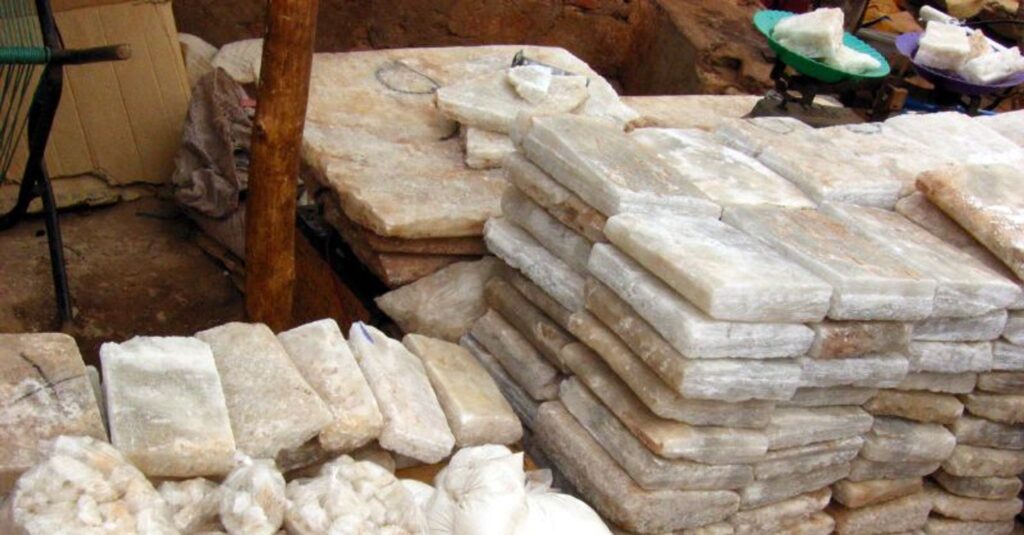
The geography behind this is dramatic. Salt was mined at sites deep in the
Sahara — Taghaza and Taoudenni among the most significant — cut into slabs,
and loaded onto camel caravans for the long journey south. Those caravans
moved salt south and carried gold north, in an exchange so central to the
regional economy that it helped fund and sustain the great trading empires of
the era: Ghana, Mali, and Songhai, whose rulers taxed the caravans passing
through their territory as a primary source of state revenue.
There’s a well-known claim that salt was traded “pound for pound” for gold in
some markets — worth mentioning honestly rather than repeating as flat fact,
since historians have debated how literally true that was in practice. But even as
an exaggeration, it captures something real: salt’s value in this system was
genuinely close to gold’s, which is remarkable for a mineral most of the world
takes for granted.
What Got Lost
Bring these three currencies together and a pattern emerges. Each represented
a distinct, functioning economic system — a manufactured trade good with
regionally negotiated value, a precision-measured commodity currency built on
craftsmanship and cultural meaning, and a scarce essential resource that
funded entire empires. None of them were primitive. All of them worked, in some
cases for centuries, before colonial currency ever arrived.
And each one carried something that colonial currency didn’t replace — it simply
discarded. Manillas carried regional trust networks and locally negotiated value
that colonial coinage never bothered to preserve. Goldweights carried
craftsmanship, status, and cultural meaning built directly into the tools of trade
itself — proverbs cast in brass, not printed on a banknote. Salt currency carried
an entire trans-Saharan political and economic order, one that had funded
empires long before Europe had any commercial foothold on the West African
coast.
The Myth vs. The Reality
| What people assume | What actually happened |
|---|---|
| Pre-colonial West African currency was primitive, informal, or close to barter | Three distinct, sophisticated systems existed — a manufactured trade currency, a precision-measured commodity currency, and a geopolitically significant resource currency |
| Manillas were purely a symbol of African commerce | By the 19th century, most were manufactured in industrial Britain and shipped in to match African market standards |
| Gold dust trade was loosely and informally exchanged | It relied on a precise, culturally rich weighing system refined over centuries, shaped by cross-regional contact with the Islamic trading world |
| Salt was just a minor trade good among many | It was valuable enough to help fund empires, and rulers taxed its movement as a core source of state revenue |
Why This Still Matters
These weren’t relics waiting patiently to be modernized by colonial currency. They were
functioning economies with their own internal logic, precision, and value — systems that
took centuries to build and that colonial replacement erased not because they failed, but
because they didn’t serve colonial interests. Getting that distinction right is part of
setting the record straight.
Next in this series: how West Africa’s own indigenous trade networks — the ones running
long before any European institution arrived — actually worked.