
This wasn’t eight separate colonies that happened to share a flag.
It was one deliberately engineered federation, run out of a single office in Dakar,
built specifically so France could extract resources, labor, and revenue as
efficiently as possible across an enormous stretch of territory — not to develop
it, and not to represent the people living in it.
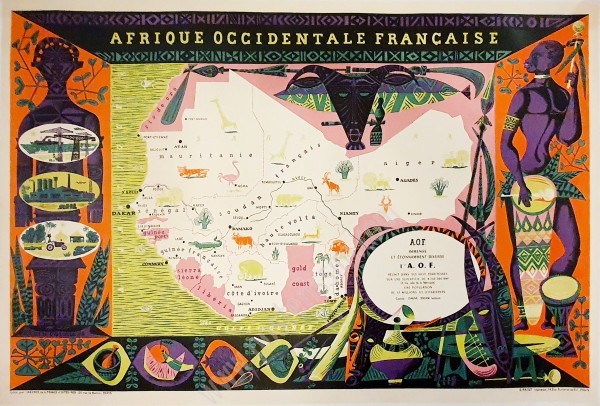
Eight territories, folded into a single administrative machine: Senegal, French
Sudan (now Mali), French Guinea, Côte d’Ivoire, Upper Volta (now Burkina Faso),
Dahomey (now Benin), Niger, and Mauritania.
AOF wasn’t a government. It was an org chart built for extraction, with “colonies”
listed as the line items.
Here’s What Actually Happened
Let’s trace how this actually came together, because the origin story explains a
lot about what it was designed to do.
French West Africa — Afrique Occidentale Française, or AOF — was created by
decree on June 16, 1895. It started with four colonies: Senegal, Sudan, Guinea, and
Côte d’Ivoire, and expanded over the following decades to encompass all eight
territories.
Here’s the “why now” that matters. Through the 1880s and into the 1890s, French
military officers had been expanding territory on their own initiative during the
broader European “Scramble for Africa” — grabbing land, signing treaties,
pushing borders outward, often with limited oversight from Paris. By the late
1890s, the French government moved to rein that in. Consolidating everything
under a single civilian governor-general, answerable directly to the Ministry of
Colonies, served two purposes at once: controlling the cost of running an
increasingly sprawling territory, and reasserting civilian control over a military
that had been operating with too much independence.
Jean-Baptiste Chaudié became the first governor-general in 1895, based initially
at Saint-Louis, Senegal. In 1902, the capital moved to Dakar — a better-positioned
port for administering, and more importantly, shipping from, the entire
federation.
Here’s the myth-check. AOF wasn’t a single, uniformly administered colony where
everyone experienced French rule the same way. It was a layered administrative
pyramid: a governor-general in Dakar at the top, lieutenant governors beneath
him running each individual territory, and below that, the cercle system — small
administrative units, each headed by a single European officer, carving the
population into governable, extractable units with little regard for existing
political, ethnic, or community boundaries.
A System Built to Extract, Not Represent
Here’s the core design logic worth sitting with: AOF centralized budgets, customs
revenue, and policy decisions in Dakar specifically so France could manage the
entire federation as one efficient economic unit — squeezing resources out at
the lowest possible administrative cost, rather than building institutions that
actually served the people living under them.
The clearest evidence of that priority is the indigénat system. This was a legal
regime that let any French official summarily punish African subjects for a
defined list of minor “offenses” — with no right of appeal, and explicitly not
applied to French citizens or Africans who had been granted “assimilated” status.
The list of punishable offenses started small, around sixteen identified
infractions, and grew significantly over time: by 1907, French Sudan’s list had
expanded to 24 offenses; by 1918, Côte d’Ivoire’s list had grown to 54.
This matters directly for understanding the region’s trade and economic history,
because the indigénat wasn’t just a policing tool for public order — it was an
enforcement mechanism that kept the entire colonial economic system running.
Failing to pay a tax, or simply failing to show an administrator what the colonial
system considered adequate “respect,” could trigger summary punishment with
no legal recourse.
Forced labor ran alongside this. Labor obligations known as prestations
required West Africans to work on colonial infrastructure projects, and mass
recruitment — including into the tirailleurs sénégalais, West African soldiers
serving French military campaigns — pulled enormous numbers of men out of
their communities, especially intensifying during and after World War I.
Development for Whom?
Under governors like William Merlaud-Ponty, who led AOF from 1908 to 1915, the
federation began pursuing more visible “economic development” and education
policy. But it’s worth being precise about what that development was actually
oriented toward: infrastructure — railways, ports — built to move extracted
resources out of the interior efficiently, not to connect or serve African
communities on their own terms.
This is the direct institutional backdrop for several stories already covered in this
series: the forced cotton schemes, the railway lines built toward coastal ports
rather than toward regional connection, and the currency and taxation systems
designed specifically to push people into the colonial cash economy. None of
that infrastructure emerged from a neutral development agenda. It came out of
AOF’s founding logic.
Even the language used to describe this era gives it away. French colonial policy
at the time often invoked the idea of “mise en valeur” — roughly, “developing the
value” of the territory. That phrase sounds like progress. In practice, it was
revenue-and-extraction language dressed up as a civilizing mission.
The Myth vs. The Reality
| What people assume | What actually happened |
|---|---|
| AOF was a unified colonial government administering French West Africa for order and development | It was a centralized extraction machine, built to manage eight territories as one efficient economic unit at the lowest possible administrative cost |
| French colonial subjects had access to the same legal protections as French citizens | The indigénat system allowed summary punishment of African subjects with no right of appeal — a punishment regime explicitly excluding French citizens |
| Colonial “development” projects like railways and ports were built to benefit local populations | Infrastructure was built primarily to move extracted resources out of the interior efficiently, not to connect or serve African communities |
| AOF’s administrative structure treated all its territories and people uniformly | It operated as a layered pyramid — governor-general, lieutenant governors, and cercle officers — dividing populations into governable units regardless of existing community boundaries |
Why This Still Matters
AOF is the administrative skeleton behind almost everything already covered in
this series — the currency systems, the taxation regimes, the forced labor, the
infrastructure built toward export rather than access. None of those individual
stories happened in isolation. They happened inside a federation specifically
engineered to make extraction efficient.
The federation existed until 1958. That means the same extraction-first framework
that took shape in 1895 shaped the region’s economy for well over six decades —
right up to the edge of independence.
Next in this series: the CFA franc’s creation in 1945 — a currency built to outlive
the empire that made it.