
A Historical In-depth Discovery of Trade in West Africa Since 1896
Here’s what you need to know:
- CBG was formed on October 1, 1963, as a joint venture between the government of newly independent Guinea (49% ownership) and Halco Mining, then largely represented by Harvey Aluminium of Delaware (51% ownership) — but according to CBG’s own official corporate history, virtually no physical construction occurred for the next seven years.
- Actual civil engineering work — including the critical railway line — didn’t begin until 1970, with the bulk of construction compressed into a rapid three-year window between 1970 and 1973, partly financed by a World Bank loan.
- The scandal isn’t a single dramatic event — it’s the seven largely undocumented years between CBG’s 1963 formation and 1970, sitting inside the broader, difficult context of newly independent Guinea’s international isolation following its 1958 break from France, during which one of the world’s richest bauxite deposits sat entirely undeveloped.
The Formation: What Actually Got Signed in 1963
CBG’s formal creation on October 1, 1963 is worth understanding within its precise historical context. Guinea had gained independence from France in 1958 — the only French West African territory to vote against remaining within a French-led community, a decision that resulted in immediate and severe French retaliation, including the abrupt withdrawal of French personnel, equipment, and financial support from the newly independent country. This left Guinea, under President Ahmed Sékou Touré, in a genuinely precarious international position for its first several years of independence, cut off from its former colonial patron and searching for alternative international partners.
CBG’s own official corporate timeline uses a specific and telling word to describe its 1963 formation: the company “resumed its excavations” that October — language suggesting that some prior exploration activity, likely tied to Harvey Aluminium’s earlier prospecting interest in the Boké region, had previously been paused. This detail is worth connecting directly to Guinea’s broader diplomatic trajectory: the country joined the World Bank in 1962, just one year before CBG’s formal restart — suggesting Guinea’s gradual re-entry into international financial institutions may have been a direct precondition for the bauxite partnership actually being able to proceed at all.
The ownership structure itself is worth stating precisely, since it established the framework this blog has already examined in Guinea’s more recent bauxite disputes: the Guinean government held 49%, with the remaining 51% controlled by Halco, whose ownership at this early stage was centered on Harvey Aluminium of Delaware — the same minority-government-stake structure that has persisted, in modified form, through decades of subsequent ownership changes.
The Real Gap: What CBG’s Own History Doesn’t Show for Seven Years
Here is the piece’s central finding, worth stating directly because it complicates the simple assumption that a decade-long delay merely reflects the ordinary complexity of building major mining infrastructure. CBG’s own official corporate timeline lists no significant construction milestones at all between the company’s October 1963 formation and July 1970, when execution of civil engineering works — explicitly including the critical railway line — finally began. Seven years pass in the company’s own documented history with essentially nothing recorded.
This gap deserves scrutiny rather than simple acceptance as an unremarkable feature of large infrastructure projects. Guinea in this period remained a genuinely difficult environment for major Western corporate and financial partnerships: Sékou Touré’s government pursued a broadly socialist, non-aligned foreign policy stance during the height of the Cold War, maintaining relationships with the Soviet Union and other Eastern Bloc states that complicated its standing with Western financial institutions and multinational corporations. Whatever the precise combination of financing negotiations, political risk assessment, and diplomatic maneuvering that filled these seven years, the practical result was that one of the world’s richest bauxite deposits — already formally allocated to a joint venture — sat almost entirely undeveloped for the better part of a decade.
The Sprint: What Happened Once Construction Actually Began
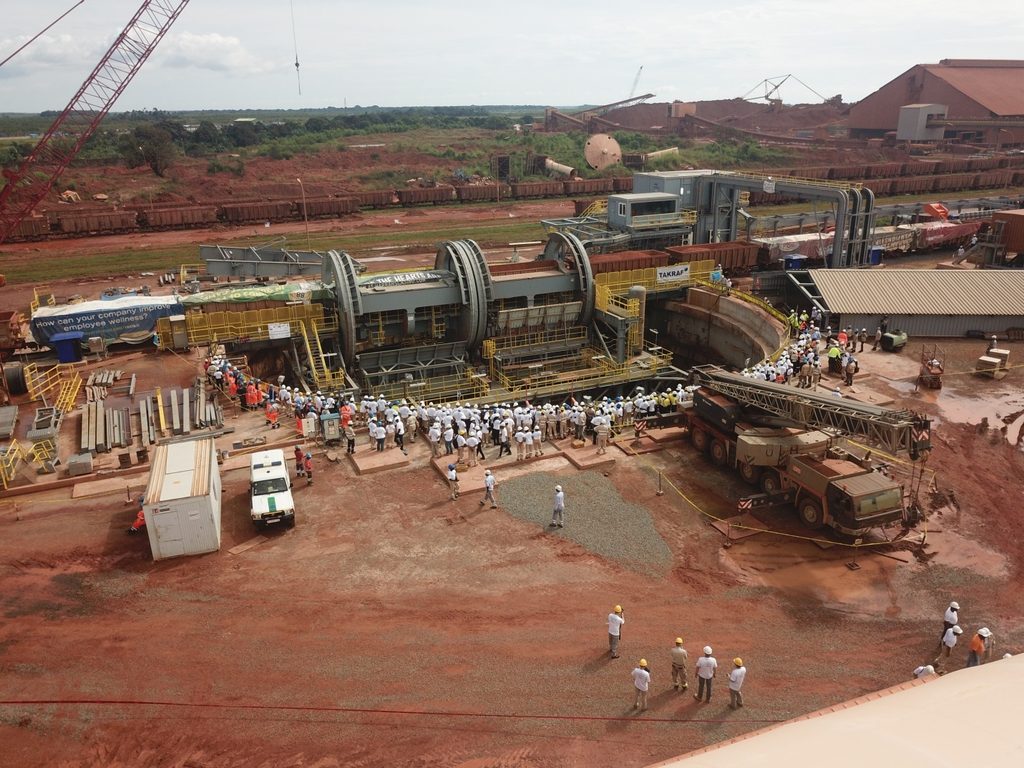
Once the seven-year gap ended, construction proceeded with genuine speed, worth documenting precisely since it shows the delay was not primarily a matter of technical or engineering difficulty. Civil engineering works, including the 125 to 136-kilometer railway line connecting the Sangarédi mines to the deep-water port at Kamsar, ran from July 1970 through the end of 1972. Construction of the Kamsar plant infrastructure began in early 1971, alongside construction of the Sangarédi township and industrial zone running from 1971 to 1973.
The final months moved with remarkable precision, worth noting for how tightly sequenced they were: the railway line to Kamsar was completed in January 1973. The first diesel power generators at both Kamsar and Sangarédi came online in March 1973. The first mining shovel entered service in April 1973, the same month the first train departed Sangarédi. Bauxite crushing and storage operations at Kamsar began on April 30, 1973. Ownership of the railway itself transferred to OFAB/CBG on June 1, 1973. And on August 2, 1973, the first loaded vessel — a ship named the Coronia — departed Kamsar carrying 19,000 tons of Guinean bauxite, a full decade after the joint venture’s original 1963 formation.
This construction phase was partly financed through international lending, worth including for context: World Bank documentation confirms a specific loan (Loan 557-GUI) supported the broader Boké bauxite infrastructure buildout, with a formal Construction Coordination Committee established at the Bank’s own suggestion to coordinate the various parties’ planning and construction efforts — meaning the financing and institutional framework that finally allowed rapid construction to proceed in 1970 required exactly the kind of international financial institution backing Guinea’s own difficult diplomatic position had likely delayed securing for years beforehand.
What Guinea Actually Lost During This Decade
It’s worth stating plainly what this ten-year gap actually cost Guinea, beyond the abstract observation that development was delayed. Every year between 1963 and 1973 that CBG’s bauxite remained unextracted was a year of foregone export revenue, foregone employment, and foregone foreign exchange earnings for a newly independent nation already struggling economically following its abrupt 1958 break from France. Guinea held, even at this early stage, direct knowledge that it possessed one of the world’s most valuable bauxite deposits — the specific resource wealth already documented extensively elsewhere in this blog’s coverage of Guinea’s later, ongoing bauxite disputes — and yet a full decade passed between formally partnering to develop that resource and actually seeing the first ship depart with product to sell.
Close
The ten years separating CBG’s 1963 formation from its first 1973 bauxite shipment were not simply a decade of unavoidable, ordinary infrastructure-building delay. The company’s own corporate history reveals that the actual physical construction — railway, port facility, industrial township — was compressed into roughly three genuinely fast-moving years once it finally began in 1970.
The other seven years, largely undocumented in CBG’s own timeline, sat inside Guinea’s broader, difficult post-independence position: a newly sovereign nation navigating international isolation following its break from France, only gradually rebuilding the international financial relationships — beginning with its 1962 World Bank membership — that would eventually make large-scale foreign investment in its own resource wealth actually possible. Guinea waited a decade to begin cashing in on one of the richest bauxite deposits on Earth, and the reasons for that wait trace as much to the country’s broader geopolitical position as to any genuine technical complexity in building a railway and a port.
Sources and further reading.