

A private company once had the legal power to tax people, write laws, run courts,
and keep its own armed force — across an area roughly the size of a European
country.
Not a colonial office. Not the British Crown. A company. With shareholders.
Answering to a boardroom in London, not to the roughly half a million square
miles of Niger and Benue river territory it governed.
This wasn’t a business with government contracts. For over a decade, before
Britain’s Crown ever formally ruled a single acre of the region that would become
Nigeria, this was a government with a shareholder list.
Here’s What Actually Happened
Let’s slow down and get the actual sequence of events, because this story didn’t
start with a charter — it started with a merger.
In 1879, a British businessman named George Goldie looked at the Niger River
trade and saw a problem: too many British trading firms were competing against
each other, driving up costs and weakening Britain’s position against French
rivals also pushing into the region. His solution was to consolidate those
competing firms into a single organization, originally known as the United
African Company. In 1881, it was renamed the National African Company.
Goldie’s real weapon in these early years wasn’t ships or soldiers — it was
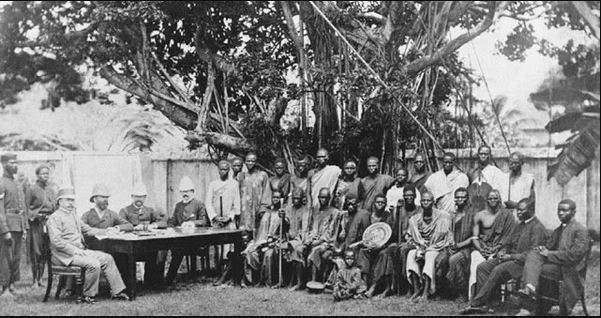
paperwork. His agents fanned out and signed more than 400 treaties with local
rulers along the Niger and Benue rivers, including agreements with the powerful
Emirs of Sokoto and Gando in 1885. These treaties weren’t just business
arrangements. They became the legal foundation Britain would later point to at
the Berlin Conference to justify its claim over the territory — proof, on paper, of
British commercial “presence” in the region.
Then, in July 1886, the British government granted Goldie’s company a royal
charter. It was renamed the Royal Niger Company.
Here’s the part that needs unpacking, because “royal charter” sounds like a
branding exercise, and it was anything but. A royal charter of this kind didn’t just
give a company permission to operate — it handed the company sovereign-style
powers normally reserved for a government. The Royal Niger Company’s charter
authorized it to collect customs duties, administer justice, maintain an armed
force, and negotiate treaties on behalf of the British Crown. This was a
well-established but unusual colonial tool: rather than Britain directly funding
and running a new colonial administration, it outsourced the cost, risk, and daily
governance of the territory to a private, profit-driven company — while that
company still operated under the authority of British law.
A Company Acting Like a Government
The Royal Niger Company set up its headquarters at Lokoja, right at the
confluence of the Niger and Benue rivers. That location wasn’t random —
whoever controlled that junction controlled the flow of trade moving in and out of
the entire interior.
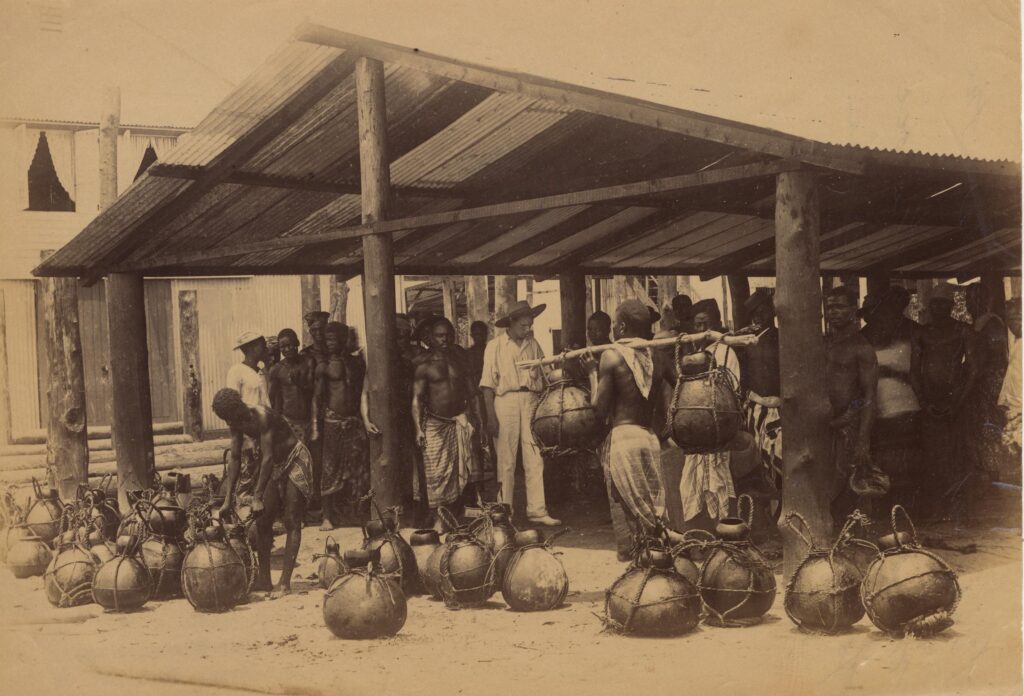
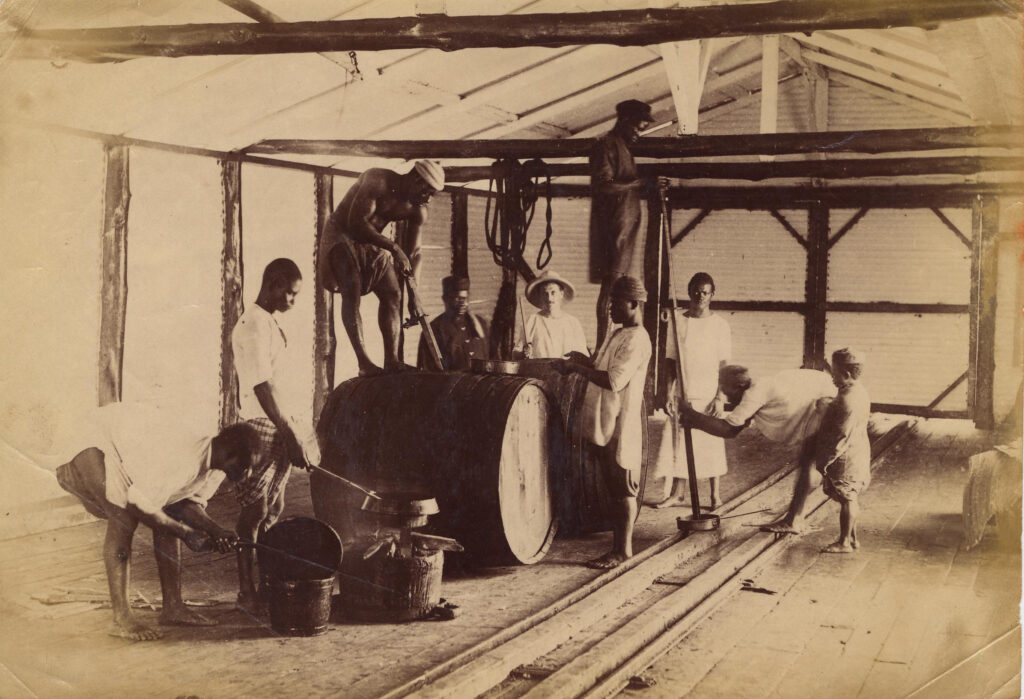
And the company didn’t just trade palm oil, one of the most valuable
commodities in the region at the time. It controlled who else was allowed to trade
it. Using its charter powers, the company enforced tariffs and trade restrictions
designed to box out competitors — not just European rivals, but African traders
who had been running their own independent commercial networks in the region
long before the company arrived.
That monopoly had a human cost, and it shows up clearly in two moments.
The first is the exile of King Jaja of Opobo in 1887. Jaja was not a passive local
ruler — he had built his own independent, highly successful palm oil trading
empire, and he had no intention of letting a British company dictate his terms of
trade. When he resisted the company’s efforts to control the market, he was
removed from his own territory and exiled. It was a direct message about what
happened to African commercial power that didn’t cooperate with the company’s
monopoly.
The second is the 1895 raid at Akassa, near Brass. Local traders in the region had
been economically strangled by the company’s trade restrictions — cut out of
markets they had operated in for generations. In response, they attacked the
company’s post at Akassa. This wasn’t a random outbreak of violence. It was a
direct protest against being shut out of trade in their own territory by an outside
company enforcing a legal monopoly most of them had never agreed to.
The Beginning of the End
By the late 1890s, cracks were showing. France and Germany were pressing rival
territorial claims nearby, and disputes over borders kept escalating into
diplomatic headaches for London. Local unrest, driven by years of monopoly
enforcement, wasn’t going away either. And there was a growing discomfort in
Britain itself with the arrangement: was it really sound policy to let a private
company — accountable to shareholders, not to the Crown — represent British
interests in international border disputes and local governance?
The answer, eventually, was no.
In 1899, the British Parliament passed the Royal Niger Company Act, formally
revoking the company’s charter. Britain paid the company roughly £865,000 in
compensation for handing over its territorial holdings and administrative role.
On January 1, 1900, the transfer became official: the territory the company had
governed became the Northern and Southern Nigeria Protectorates, now under
direct British colonial administration. Those two protectorates would later be
merged in 1914 into a single colonial entity — the one that carried the name
“Nigeria” into independence in 1960.
The Myth vs. The Reality
| What people assume | What actually happened |
|---|---|
| Britain colonized Nigeria directly, from the start | A private company governed the region — collecting taxes, enforcing law, keeping an armed force — for over a decade before the British Crown took formal control |
| Chartered companies were just businesses with government approval | The Royal Niger Company’s charter gave it sovereign-style powers: treaty-making, taxation, and justice administration, not just trading rights |
| The “free trade” language from the Berlin Conference meant trade stayed open and competitive | The Royal Niger Company used its charter to enforce a strict monopoly, boxing out both African and European competitors |
| Nigeria as a single territory existed from the beginning of colonial rule | It didn’t take shape as one entity until 1914, when the Northern and Southern Protectorates — created after the company’s charter was revoked — were merged |
Why This Still Matters
Nigeria’s first real “government,” in practice, wasn’t a colonial office or a local
ruling structure. It was a boardroom in London, answering to shareholders,
enforcing its authority through trade monopoly and treaty paperwork rather
than public consent.
That matters beyond the history itself. The administrative boundaries, trade
routes, and patterns of centralized control established during the Royal Niger
Company era didn’t vanish when the charter was revoked — they became part of
the foundation the colonial state was built on, and later, the post-colonial one.
When you’re tracing why certain trade patterns and infrastructure decisions in
Nigeria look the way they do today, this is one of the places the trail starts.
Next in this series: how colonial currency replaced West Africa’s own systems of
money — and what got lost in that transition.