
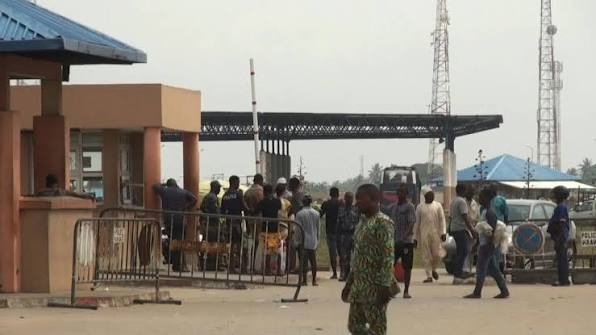
● Benin reopens its border with Niger in line with ECOWAS’s extraordinary
Abuja summit decision. (March 2024)
Following ECOWAS’s extraordinary February 24, 2024 Abuja summit lifting
sanctions on Niger, Benin did exactly what was asked. It reopened its border in
compliance with the regional decision.
Niger did not.
This is a story best told through two competing public statements, made months
apart, by the two leaders at the center of it — because what each man actually
said reveals more about the standoff than any neutral summary could.
Section One: Benin’s Statement — “Not an Enemy Country”
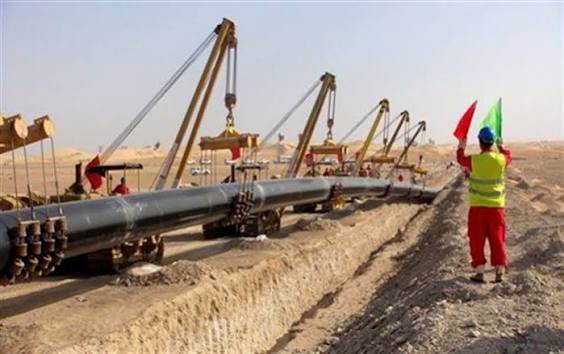
The immediate economic stakes here are worth setting out plainly. Niger had just
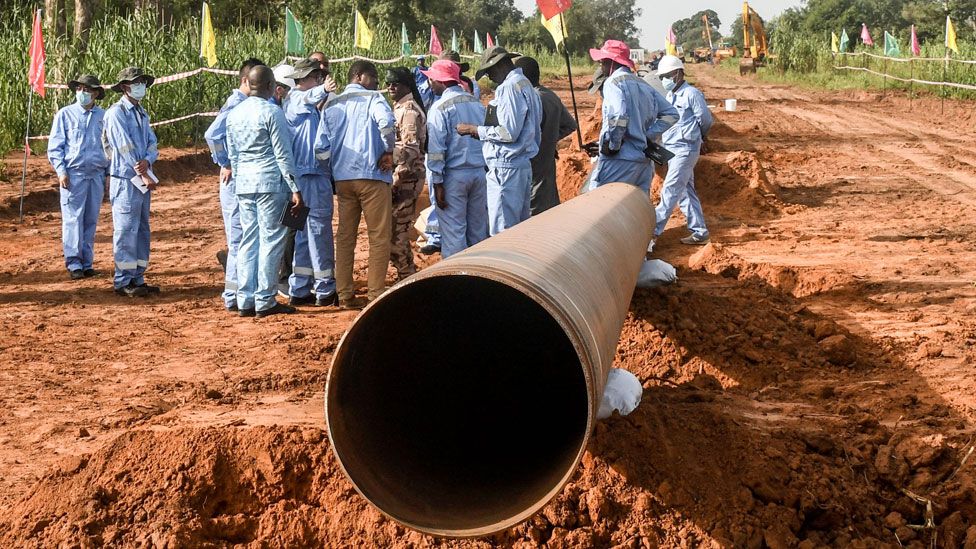
completed a 2,000-kilometer, Chinese-built oil pipeline running from its Agadem
Rift Basin fields through Benin to the port of Seme-Kpodji — a project expected to
raise Niger’s oil production from around 20,000 barrels a day for domestic use to
as much as 110,000 barrels a day for export.
When Benin blocked Niger from loading its first crude oil shipment in March
2024, President Patrice Talon stated the terms plainly: “If you want to load your oil
in our waters, you must consider that Benin is not an enemy country and that its
territory cannot be the subject of illicit trafficking or informal exchange.” He
added a direct offer alongside the warning: “If tomorrow the Nigerien authorities
decide to collaborate with Benin in a formal manner, the boats will be loaded.”
Benin’s actual position and leverage here are worth understanding clearly, since
this is a genuinely two-sided economic dispute, not a simple villain-and-victim
story. Benin had complied with ECOWAS’s directive to reopen its border, and was
now using its control over Niger’s only viable oil export route as direct leverage to
demand Niger reciprocate.
It’s worth explaining why this pipeline mattered so much to both economies. Niger
needed it to unlock a major new export revenue stream as a landlocked,
oil-producing nation. Benin, meanwhile, stood to earn millions of dollars in
transit fees it was now being deprived of by the standoff — meaning both sides
had genuine financial skin in this dispute, not just political posturing.
Section Two: Niger’s Statement — “This Will Betray the
Aspirations of the Nigerien People”
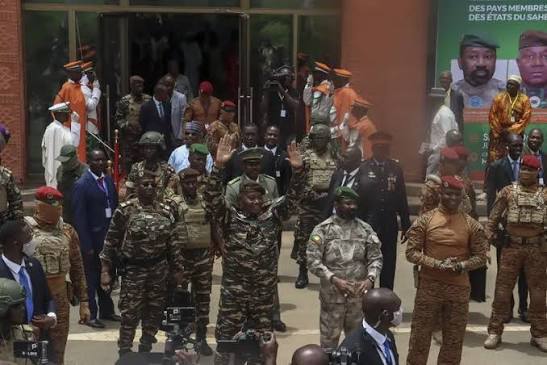
Niger’s countervailing position is worth bringing in directly. Junta leader
Abdourahamane Tchiani refused to reopen Niger’s side of the border, accusing
Benin of hosting French military bases aimed at “destabilising” Niger — a claim
both Benin and France have consistently and directly denied.
Tchiani’s own words on the standoff are worth quoting at length. Speaking at a
rally near the border in Gaya, he insisted the crossing would “remain closed,”
declaring that reopening it would “betray the aspirations of the Nigerien people.”
Separately, he alleged Western countries were using Benin to “finance and
support terrorism” aimed at destabilizing the AES.
Here’s where the scandal enters, sourced directly to independent analysis. One
detailed regional analysis found that Tchiani’s accusation against Benin “mirrors
an unsubstantiated accusation he made roughly a year ago” — almost word for
word — characterizing the claim as functioning “primarily as a domestic political
tactic” rather than a genuine, evidence-based security doctrine. The analysis
suggested this kind of recycled rhetoric tends to surface specifically during
periods of acute pressure on the junta’s grip on power.
This isn’t simply a case of two governments disagreeing about security facts. It’s a
case where independent observers have directly characterized one side’s central
justification as a repeated, unsubstantiated talking point used to redirect public
attention, rather than address governance or security failures at home.
Section Three: The Middle Ground Nobody Occupies
There are real casualties sitting between these two statements. A Beninese court
sentenced three Nigerien nationals to 18-month suspended prison terms for
allegedly falsifying documents to enter the port — men Niger insists were
legitimate WAPCO pipeline employees, not smugglers.
There’s an armed dimension too, which complicates any simple narrative of two
governments talking past each other. The Patriotic Liberation Front, a rebel
group fighting for the release of the deposed President Bazoum, claimed
responsibility for sabotaging the pipeline in June 2024, adding a third actor with
its own stake in keeping the standoff unresolved.
The human cost is worth hearing in an on-the-ground voice rather than a
government statement. Ibrahim Abou Koura, a Nigerien haulier based in
Cotonou, put it plainly: “Those who are suffering are the people of both
countries.” A reminder that neither government’s public statements have
addressed the ordinary traders and travelers caught in between.
Benin made one further attempted goodwill gesture worth noting, and its
rejection is telling in itself. Benin invited Niger and Burkina Faso to send troops
to its national day parade as a gesture of reconciliation. Both AES members
declined.
Close: Two Statements, No Resolution
The pipeline dispute did eventually see some movement, though it’s worth not
overstating it as resolution. Oil exports through Seme-Kpodji resumed in late
2024 after months of disruption, even as the underlying border remained shut
and uranium shipments stayed stalled.
Benin’s foreign minister offered a measured, ongoing hope for reconciliation,
worth quoting directly: “We are hopeful that this will be resolved quickly… the
blockage is not on Benin’s side.” He added, “We have to accept the fact that we
are not on the same wavelength sometimes… The door remains open.”
Benin made its statement through compliance — reopening its border exactly as
ECOWAS asked. Niger made its statement through refusal, repeated in
near-identical language a year apart. Between those two positions sits a pipeline,
a rebel group, three imprisoned pipeline workers, and ordinary travelers still
waiting for either side to actually change its story.
This standoff is the direct origin point for the Nigerian workaround corridor
already covered elsewhere in this blog — proof that when two neighbors’
statements never converge, trade eventually finds its way around them instead.