
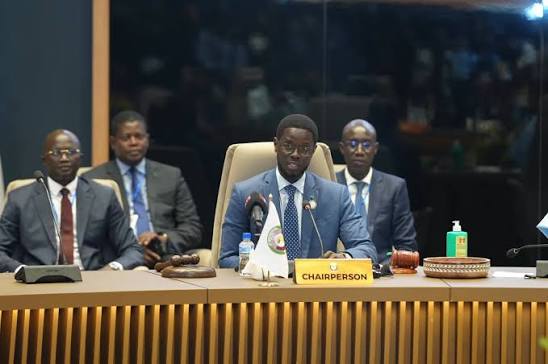
● Senegal’s President Bassirou Diomaye Faye elected ECOWAS Chairman,
taking on a leadership role amid the bloc’s AES crisis. (2025)
ECOWAS Chairman, 2025. Requirements: credibility on democratic legitimacy,
mediation experience with governments in crisis, and the standing to be taken
seriously by both coup-installed juntas and elected heads of state
simultaneously.
This is a résumé review of the man who got the job — his qualifications, his
references, and one significant red flag that surfaced less than a year into the
role.
Section One: Qualifications
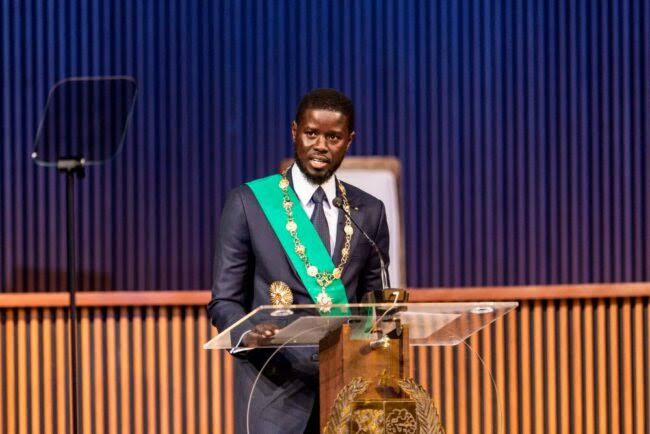
Bassirou Diomaye Faye’s actual background is worth walking through plainly. A
former tax inspector, virtually unknown nationally until 2022, he became
Senegal’s president in April 2024 at just 44 years old — one of the youngest
heads of state on the continent.
Here’s the credential that makes him genuinely distinctive for this specific role:
Faye came to office having personally experienced the exact kind of democratic
crisis ECOWAS now spends most of its time managing across the region.
The actual crisis is essential context. In February 2024, President Macky Sall
postponed Senegal’s scheduled presidential election, citing unresolved
candidacy disputes — a move the Constitutional Council of Senegal ultimately
overturned, forcing Sall to set a new date and release hundreds of political
prisoners, including Faye himself.
Aissata Sagna, a 39-year-old factory worker who worked on Faye’s campaign,
described what his inauguration meant to ordinary Senegalese: “It’s the
culmination of a long struggle for democracy and the rule of law.”
The qualifications case here is genuinely strong. Unlike most regional leaders
mediating the AES-ECOWAS crisis from a position of institutional continuity, Faye
is someone who was literally imprisoned during a genuine constitutional crisis in
his own country before becoming president — a credential no other candidate
for this specific job could claim.

Section Two: References
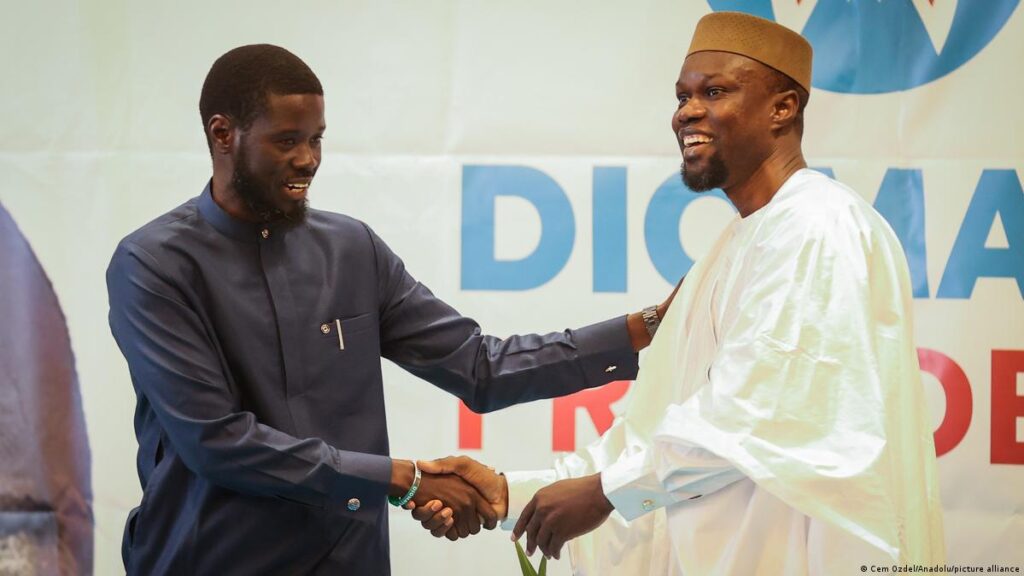
The political partnership that got Faye the presidency in the first place is worth
bringing in directly. Ousmane Sonko, the charismatic opposition figurehead who
had been barred from the 2024 race after his own conviction, personally selected
Faye as his replacement candidate.
The depth of that relationship matters for what comes later. The two shared a
political party, a prison, and a campaign slogan — “Sonko is Diomaye, Diomaye is
Sonko” — with Faye even naming one of his sons Ousmane in his ally’s honor.
The electoral result this partnership produced was decisive. Faye defeated Sall’s
preferred successor in a landslide, becoming Senegal’s fifth president, with
Sonko installed as his Prime Minister.
On paper, this looked like the strongest possible reference — a political bond so
close that international observers described the two men as functionally
inseparable.
The Scandal: The Red Flag
Here’s the rupture that undercuts everything in the references section. On May
22, 2026, President Faye dismissed his own Prime Minister, Ousmane Sonko, and
dissolved his cabinet entirely.
What actually drove the split is a genuine policy disagreement, not just a
personal falling-out. Sonko had publicly condemned several of Faye’s decisions,
most notably Faye’s move to negotiate with the IMF over $13 billion in hidden debt
accumulated under the previous Sall administration — a negotiation Sonko saw
as a betrayal of the reform agenda they had campaigned on together.
Analysis of the split, from Brookings, described it as “a new schism in Senegal”
marking “uncharted territory for Africa’s democratic beacon,” noting the irony
that these were two men who had “traditionally been strong allies — sharing a
history as tax inspectors who became political activists and opposition leaders”
together.
Here’s the scandal’s core point. The same political partnership that gave Faye his
strongest credential — proof he could build and sustain unity through genuine
crisis — collapsed within roughly two years of taking office, right around the time
Faye was stepping into a regional role that depends entirely on his capacity to
hold competing political factions together.
The irony is precise: ECOWAS handed its most sensitive mediation role, managing
a bloc fracturing between juntas and elected governments, to a leader whose
own governing partnership fractured on a remarkably similar fault line — reform
versus pragmatic compromise with international financial institutions.
Close: Does the Résumé Still Hold Up?
Both sides of this deserve honest weighing, since the case isn’t clean either way.
Faye’s imprisonment-to-presidency story remains real and remains a genuine
credential — it happened, and it gave him standing that traditional incumbents
simply don’t have when speaking to AES’s junta leaders about democratic
legitimacy.
But the Sonko rupture complicates the picture in a way ECOWAS couldn’t have
fully anticipated when it selected him. A chairman whose signature qualification
was political unity through crisis now has a very public, very recent example of
that unity failing, in his own government, over a dispute about exactly the kind of
external financial pressure AES’s leaders cite as justification for their own break
from Western-aligned institutions.
Whether Faye can still credibly chair ECOWAS through its most serious crisis in
fifty years may depend less on his résumé’s strongest line than on whether
anyone — including AES’s leadership — was paying close attention to the newest
one.