

Roughly 800,000 African livelihoods, in Kenya alone, tied to a single US trade
program. Nearly 67,000 direct jobs in Kenyan apparel factories, three-quarters of
them held by women.
At midnight on September 30, 2025, that 25-year-old program simply expired. Not
because Congress debated it and voted it down. Because it got tangled up in an
unrelated US government shutdown, and nobody moved fast enough to save it.
A quarter-century of trade policy didn’t die in a dramatic vote. It died from
neglect, at the exact same midnight as a budget fight that had nothing to do with
Africa at all.
Here’s What Actually Happened
The African Growth and Opportunity Act, established by President Bill Clinton in
2000, gave eligible sub-Saharan African countries duty-free access to the US
market for thousands of products. Multiple analysts describe it as the
cornerstone of US-Africa trade policy for a generation.
AGOA officially lapsed on September 30, 2025, at the same midnight deadline as
a US government shutdown triggered by an unrelated failure to pass a federal
spending bill.
The impact was immediate and widespread. Thirty-two beneficiary African
countries, including 21 least-developed nations, lost preferential access for over
1,800 products overnight — with Kenya’s textile and apparel sector, employing
more than 66,000 people, hit hardest and fastest.
Here’s the myth-check. This wasn’t a case of Congress actively deciding AGOA
wasn’t worth renewing. Bipartisan renewal bills had been introduced well in
advance, including a 16-year reauthorization proposed by Senators Chris Coons
and James Risch in April 2024. Lawmakers had even tried folding a clean 16-year
renewal into the 2025 National Defense Authorization Act, only to have it
excluded on a technicality. The program lapsed despite consistent bipartisan
support, not because that support disappeared.

The Scandal: A Flagship Africa Policy Died as Collateral
Damage
Here’s the real story. One detailed analysis described AGOA’s expiration as “an
event largely ignored by America’s mainstream media,” overshadowed entirely by
coverage of the government shutdown happening at the exact same moment.
A specific warning had already been delivered to Congress months before the
lapse. In testimony before the House Ways and Means Subcommittee on Trade,
one analyst warned that “champagne corks will pop in Beijing and Moscow over
our failure to renew AGOA” — a direct statement that America’s own trade
competitors stood to benefit from Washington’s inaction.
That warning mattered for a specific reason. China had already been deepening
economic ties across Africa through its Belt and Road Initiative, and analysts
had explicitly flagged that a US failure to renew AGOA would hand China an even
larger opening to become the continent’s dominant trade partner, at America’s
own expense.
Here’s the scandal’s core point, stated precisely. This wasn’t a case of American
policymakers weighing AGOA’s costs and benefits and deciding it wasn’t worth
keeping. It was a functioning, broadly supported trade program that fell through
the cracks of an unrelated domestic political fight — while hundreds of
thousands of African jobs, and America’s own strategic position on the continent,
hung in the balance.
The “Extension” That Didn’t Actually Fix Anything
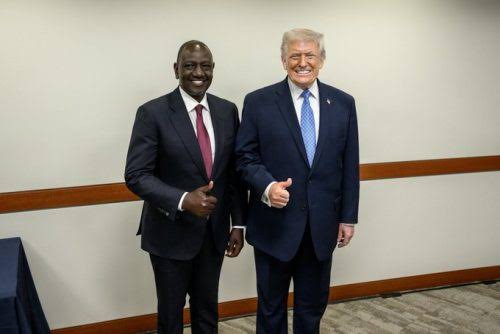
Congress eventually passed legislation extending AGOA to December 31, 2026,
retroactive to September 30, 2025, as part of a wider budget bill — with President
Trump signing the short-term renewal in February 2026.
Here’s the twist that undercuts the celebration, and it’s essential context. This “fix”
came only after President Trump had already imposed sweeping “reciprocal”
tariffs on nearly all countries in April 2025, ranging from 20% to 60% for many
African nations, with Lesotho, Mauritius, and Madagascar hit especially hard.
These tariffs wiped out most of the actual value AGOA’s duty-free access was
supposed to provide.
The hard data proves the point. According to the Trade Law Centre (TRALAC),
AGOA exports still dropped 32% in the year ending November 2025, compared to
2024, even accounting for the eventual renewal. South African auto exports
under AGOA specifically plunged nearly 75%, from over 25,000 vehicles to just
6,530.
Extending AGOA’s legal existence didn’t restore its practical value. The reciprocal
tariffs sitting on top of it meant the program’s core benefit — duty-free access —
had already been largely neutralized before the ink on the renewal was even dry.
The Myth vs. The Reality
| What people assume | What actually happened |
|---|---|
| AGOA lapsed because Congress and the Trump administration decided the program wasn’t worth continuing | AGOA lapsed despite sustained bipartisan support, as collateral damage of an unrelated government shutdown |
| The lapse was a major, closely covered story given the number of jobs at stake | It was largely overshadowed by shutdown coverage in mainstream US media |
| The February 2026 extension restored AGOA’s benefits for African exporters | Even after the extension, AGOA-covered exports remained down 32% year-on-year, because separate reciprocal tariffs had already gutted the program’s practical value |
| South Africa’s auto sector, a major AGOA beneficiary, was largely shielded from the disruption | South African auto exports under AGOA plunged nearly 75% during the lapse period |
Why This Still Matters
Whether it’s an ECOWAS bloc losing leverage over a breakaway alliance, or a US
trade program losing relevance to its own government’s dysfunction, this series
keeps finding the same underlying lesson: the frameworks meant to structure
Africa’s trade relationships are only as strong as the political will behind them,
and that will is frequently the first thing to break.
AGOA technically survives into 2027 on paper. But for the Kenyan factory worker,
the South African auto exporter, and the hundreds of thousands of others whose
livelihoods depend on it, the practical difference between “the program lapsed”
and “the program was renewed but neutralized by other tariffs” may turn out to
be smaller than the celebratory headlines suggested.